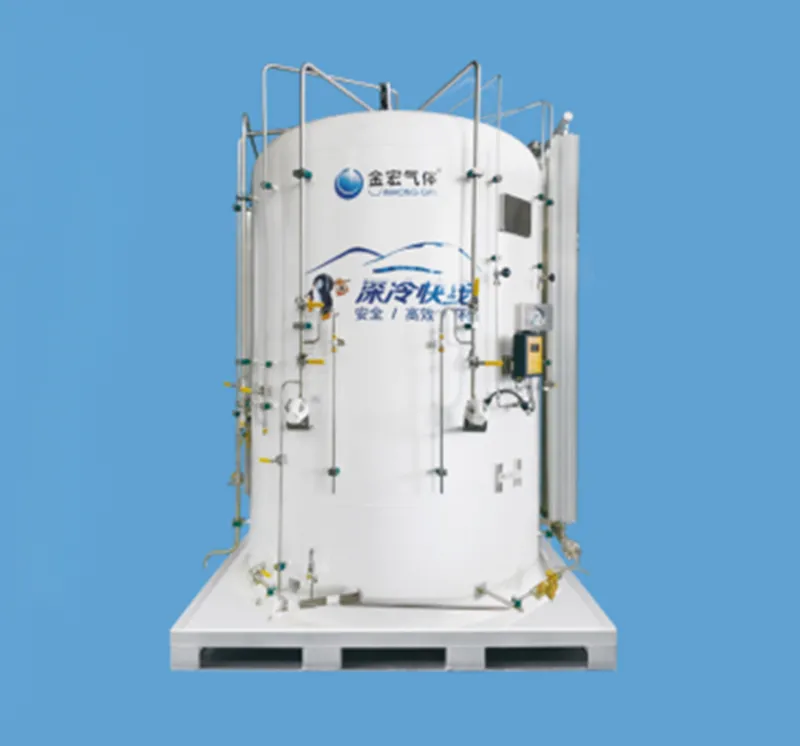
CIMC ENRIC AJT series Microbulk Storage Tank is an innovative microbulk gas storage designed for cutting, welding, cryogenic laboratories, hospitals, and many other gas users. The use of a Microbulk Storage Tank does not need frequent replacement of cylinder, no liquid residual loss, avoids the damage caused by the operation of the cylinder, and is more reliable, more efficient, and more economical. When used with tank car, the effect is more obvious.
| Parameter | Specification |
|---|---|
| Product Type | Microbulk Storage Tank |
| Series | AJT Series |
| Capacity | 1 m³–5 m³ / 1,000–5,000 L |
| Working Pressure | 1.6–3.5 MPa |
| Insulation | Multi-layer thermal insulation |
| Available Media | LNG, LOX, LIN, LAr, LCO₂ and others |
| Application | Industrial gas storage and supply |
| Installation | Indoor / Outdoor, subject to project requirements |
Click here to get a preferential quote
A microbulk tank is a small-scale cryogenic storage system designed for businesses that require a steady supply of industrial gases but do not consume enough volume to justify a full bulk tank installation.
Micobulk systems typically store liquid gases such as LNG, LOX, LIN, LAr or CO₂ and supply them directly to the user through a controlled gas distribution system.
Compared with traditional gas cylinders, microbulk tanks provide a more efficient and safer solution by eliminating frequent cylinder handling and reducing supply interruptions.
Most microbulk tanks have storage capacities ranging from 1,000 to 5,000 liters, making them ideal for medium-sized gas consumption applications.
A complete microbulk gas supply system typically consists of the cryogenic storage tank, filling connection, pressure regulation system, vaporization equipment, safety devices and gas outlet system.
Depending on the application, the system can also be equipped with level measurement, pressure monitoring and remote monitoring functions. The configuration can be adapted to the selected gas, storage capacity, working pressure and downstream gas demand.
A properly configured microbulk system allows industrial gas users to move from individual cylinder handling to a more centralized and continuous gas supply model.
Microbulk systems come with safety features like pressure relief valves and built-in monitoring systems to ensure safe operation. MicroBulk tanks provide safe on-site storage of cryogenic liquids to maximize operational safety, quality and efficiency.
MicroBulk solutions offer flexibility as your business grows. They can eliminate the need to change multiple smaller cylinders on a daily basis. Choose from the following sizes in high pressure (HP) or very high pressure (VHP) sizes: 1,000, 1,500, 2,000 and 3,000 litres. Tanks can be installed and operated indoors or outdoors and are much simpler to install than standard bulk tanks.
Microbulk systems typically hold between 230 and 6,000 liters (61 to 1,585 gallons) of gas. This capacity is higher than individual gas cylinders but smaller than bulk liquid storage tanks.
Convenience, allowing uninterrupted LNG supply, remote control and monitoring of pressure and capacity, no cylinder handling and replacement, reduced inventory management
Increased productivity and savings, reduced downtime for LNG cylinder changes, no residual returns to LNG suppliers, more efficient accounting and ordering, minimal LNG inventory maintenance, productive use of LNG for labour Efficient use of LNG production space, reduced maintenance costs
High quality, consistent assurance of high LNG purity, higher product yields and uniform supply
Improved safety, elimination of LNG cylinder handling, no cylinder leaks, low pressure tanks instead of high pressure cylinders.
Many microbulk systems offer remote monitoring capabilities, allowing suppliers to track the gas levels and system performance, ensuring timely refills.
Microbulk solutions can supply a wide range of gases, making them suitable for various industries and applications.
Microbulk delivery can be more cost-effective compared to individual cylinders since it involves fewer delivery trips, reduced cylinder rental fees, and a streamlined supply chain.
Many industrial gas users eventually switch from cylinders to microbulk systems as their gas consumption grows.
The comparison below highlights the main differences:
| Factor | Gas Cylinders | Microbulk Tank | Bulk Cryogenic Tank |
|---|---|---|---|
| Storage Capacity | Low | Medium | High |
| Cylinder Handling | Frequent | Minimal | Minimal |
| Delivery Frequency | High | Moderate | Lower |
| Installation Footprint | Small | Moderate | Large |
| Initial Investment | Lower | Moderate | Higher |
| Suitable Gas Consumption | Low | Medium | High |
| Supply Continuity | Limited | High | High |
| Best For | Small users | Growing/medium users | Large industrial users |
For many manufacturing companies, microbulk systems offer the best balance between flexibility and supply efficiency.
Request a Microbulk Tank Quotation →
→ Medical & Healthcare
→ Metal Fabrication
→ Food & Beverage
→ Electronics Manufacturing
When selecting a microbulk tank, several practical factors should be considered:
| Selection Factor | What to Evaluate |
|---|---|
| Gas Type | LNG, LOX, LIN, LAr, CO₂ |
| Consumption Volume | Daily or weekly gas usage |
| Installation Space | Available outdoor or indoor installation area |
| Supply Method | Tank truck delivery frequency |
| Pressure Requirements | Standard or high-pressure supply |
Most industrial users choose 1m³ to 3m³ microbulk tanks for moderate gas consumption.
Working with an experienced supplier can help ensure the tank capacity and system configuration match your operational needs.
The appropriate microbulk tank capacity depends primarily on gas consumption, delivery frequency, available installation space and required supply continuity.
Smaller tanks such as 1,000L–2,000L can be considered for facilities with moderate gas consumption and relatively frequent refilling. Larger capacities, such as 3,000L–5,000L, may be more suitable when higher gas demand, longer refill intervals or greater supply continuity is required.
The final tank size should be determined based on the actual gas consumption profile, peak demand, delivery schedule and operating conditions.
| Capacity | Typical Consideration |
|---|---|
| 1,000 L | Lower gas consumption |
| 1,500–2,000 L | Moderate gas demand |
| 3,000 L | Higher consumption / longer refill intervals |
| 5,000 L | Higher storage demand / greater supply continuity |
The price of a microbulk tank can vary depending on several technical factors:
Tank capacity
Working pressure
Insulation technology
Material grade
Instrumentation and monitoring system
Delivery distance and installation requirements
For example, a 3000L microbulk tank with remote monitoring typically costs more than a basic storage tank due to additional instrumentation and safety components.
For project-based installations, suppliers usually provide customized quotations based on the complete gas supply system.
If your facility currently relies on gas cylinders but consumption is increasing, a microbulk system may significantly reduce operating costs and improve supply efficiency.
Our engineering team can assist with:
Microbulk tank sizing
Gas supply system design
Installation planning
International shipping
Request a Microbulk Tank Quotation →
CIMC ENRIC offers excellent lead times and stock availability plans to meet your needs. Our team of engineering, application and customer service experts can help you to size your industrial gas system, which can have a direct benefit to your company's bottom line.
CIMC ENRIC provides cryogenic equipment and gas storage solutions for industrial gas applications, supporting product selection and project-specific configuration.
Tank capacity, working pressure, gas type and system configuration can be selected according to project requirements.
CIMC ENRIC's product portfolio covers cryogenic storage and transportation equipment, allowing customers to source related equipment from an experienced cryogenic equipment manufacturer.
Technical support can be provided for product selection, configuration, delivery and after-sales requirements.
Q: What gases can be stored in a microbulk tank?
Microbulk tanks are commonly used to store cryogenic gases such as liquid oxygen (LOX), liquid nitrogen (LIN), liquid argon (LAr), LNG, and liquid CO₂.
Q: What is the typical capacity of a microbulk tank?
Most microbulk tanks range from 1m³ to 5m³, depending on the application and gas consumption.
Q: Is a microbulk tank safer than gas cylinders?
Microbulk systems reduce the need for cylinder handling and minimize leak risks associated with frequent cylinder replacement.
Q: What industries use microbulk systems?
Microbulk gas systems are widely used in:
metal fabrication
healthcare and medical facilities
electronics manufacturing
food processing
Copyright © CIMC ENRIC All Rights Reserved | Sitemap Technical Support  Privacy Policy | CIMC ENRIC Tag
Keywords: CIMC ENRIC LPG Products CNG Products LNG Products